
How we work, from drawing to garden
The concept sketch, the master plan, and what happens in the years after planting.
From sketch to finished garden.
Every garden starts on paper: a plan of the ground and an elevation of the building, on one sheet. Below is one scheme — a water garden on Lake Pichola, from sketch to planted garden.


The drawing comes first.
We draw by hand first, and we draw the garden and the building together.
The garden runs along a reflecting pool, with cypress holding the line of sight from the palace. Terraces step down to the water. Hover a number to see each part.
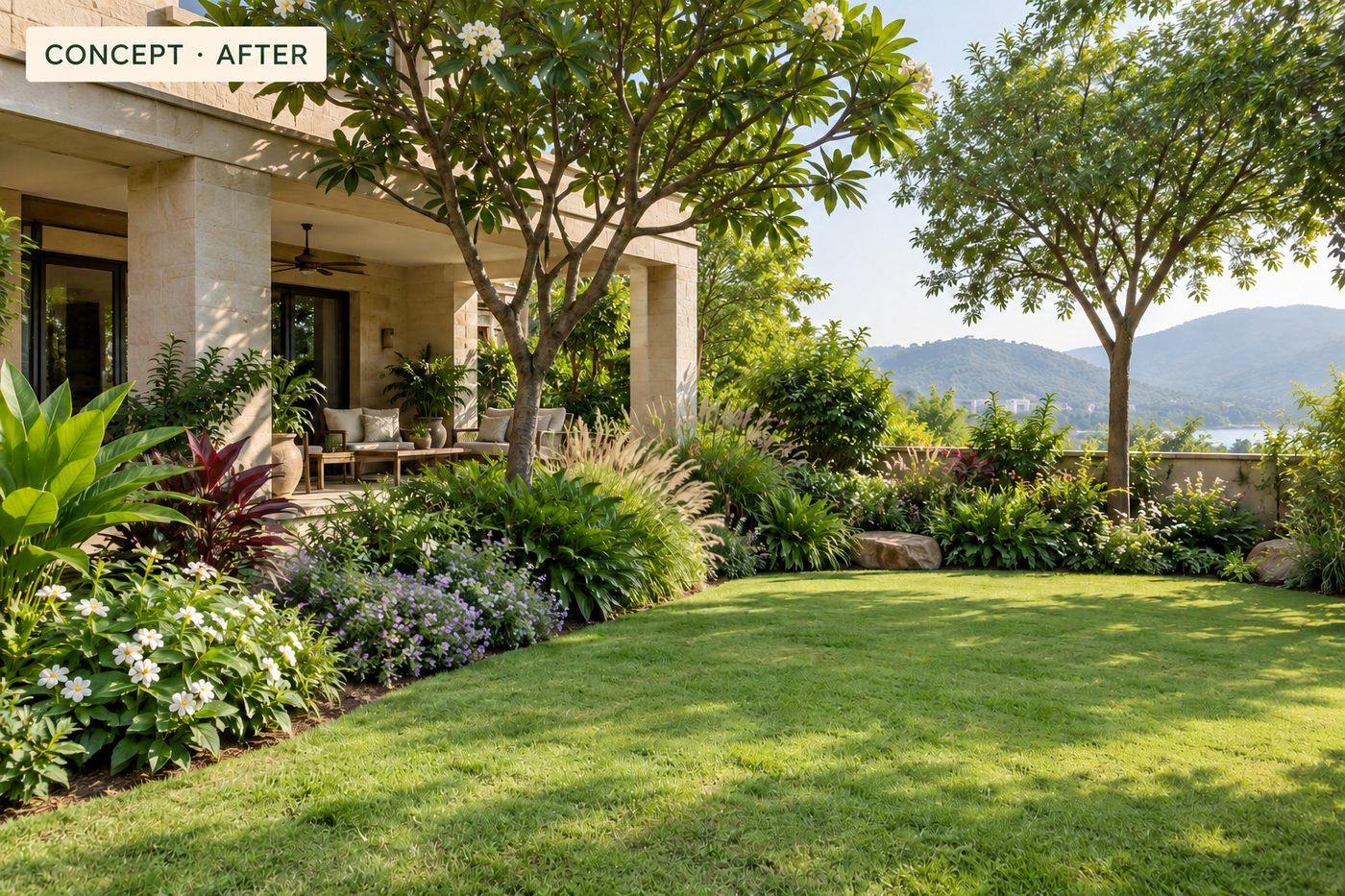
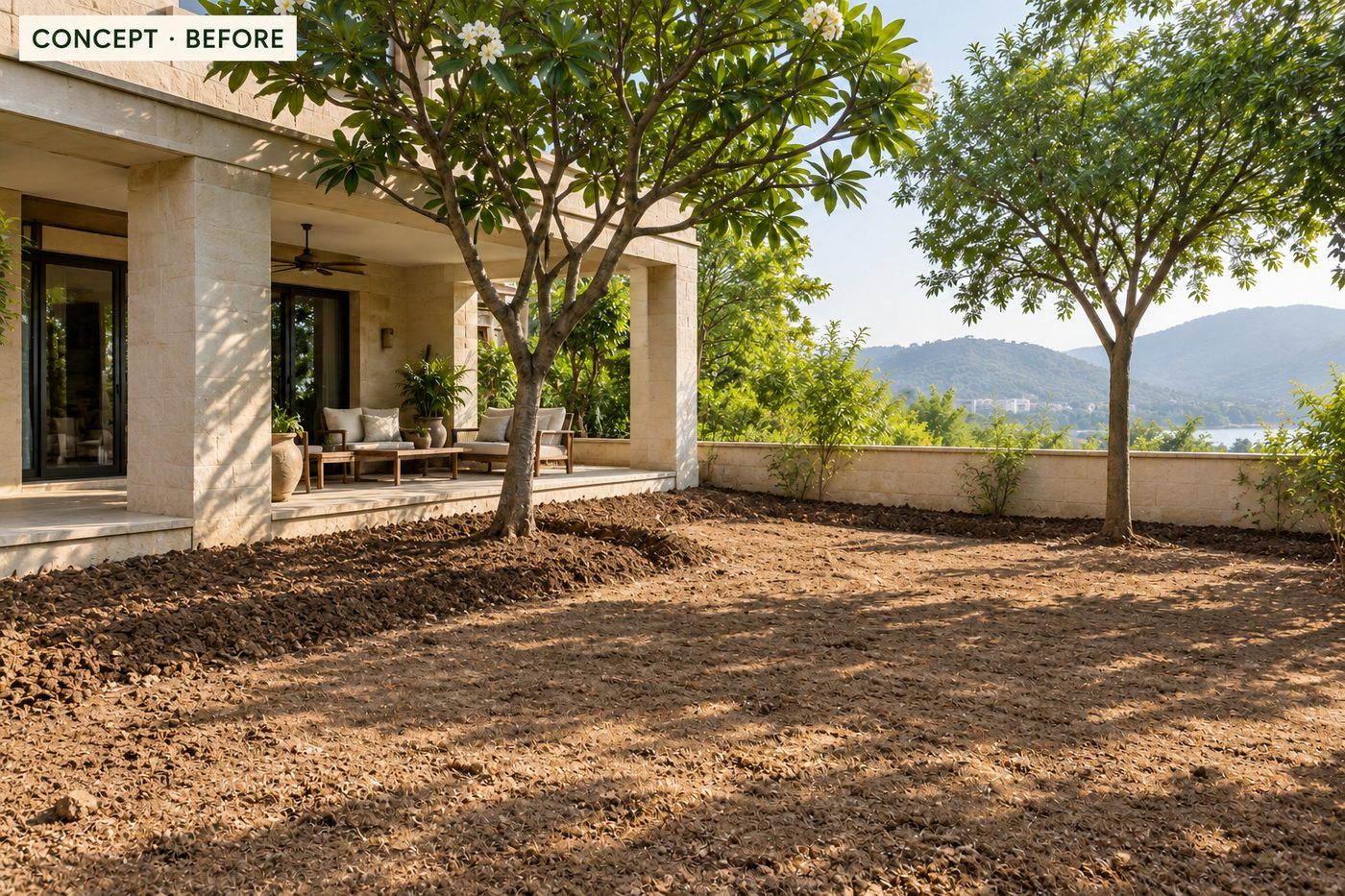
What happens between the sketch and the garden
The drawing is the start, not the job. From it we produce working drawings the crew builds from, and that you keep.
Irrigation is drawn with the planting, so pipes go in first and nothing is dug up twice. The crew that plants the garden is the crew that maintains it.
The drawings you receive
What a master plan looks like.
This is the drawing you receive before anything is dug: every lawn, bed, tree and water feature in its place. Hover a zone on the plan, or a line of the legend, to see that part of the scheme.

Charbagh parterres
Four planted quadrants in the Persian charbagh layout the Mughals brought to Rajasthan, divided by water. Seasonal colour is rotated bed by bed so the scheme never reads bare.
- A Water tank & fountain
- B Charbagh parterres
- C Cypress allée
- D Baradari pavilion
- E Pool court
- F Pergola walk
- G Kitchen garden
A garden is drawn, then it grows.
One tree, drawn the way it grows: six metres of crown above the ground and roughly the same reach of root below it. A garden is planted small and grows into the drawing over years. That is why we plan for the size a tree will become, not the size it arrives.
Planting
Pits dug wide rather than deep. Compost mixed into the soil. Each tree staked, mulched and fitted with its own drip line. Watered daily through the first summer.
What we do · plant & protectTaking root
Little happens above ground; a great deal below. Roots push out into the surrounding soil. We check weekly, feed, and do the first light pruning.
What we do · feed & watchFilling out
The canopy begins to cast real shade. Hedges close up, lawns knit together. Drip lines are moved outward as the roots spread.
What we do · shape & adjustGrown in
The garden now looks like the drawing. Pruning shapes rather than trains. Watering can drop, because the roots reach deeper on their own.
What we do · maintainMature
The trees carry the garden. Beneath them the planting is renewed in cycles, and the soil is richer than the day we started.
What we do · renew- 01Soil science
A cut through a planted lawn, two metres deep: the soil layers, what lives in them, and why we read the ground before we plant.
- 02Our principles
How we care for soil, conserve water in a desert climate, choose materials and plant for birds and butterflies.
- 03Projects
Photographs from three of our own schemes — Raj Niwas, Narsingh Bagh and Inder Prakash.